
When it comes to screaming engines, lightning-fast pit stops, and jaw-dropping overtakes, two kings rule the world of open-wheel racing: Formula 1 (F1) and IndyCar. But which one is actually faster? That’s a question that sparks debates among racing fans around the globe. Let’s break it down and compare the speed and style of these two motorsport giants.
TL;DR – Too Long, Didn’t Read
F1 is generally faster on road and street circuits, thanks to its advanced technology, lighter chassis, and insane downforce. IndyCars are faster on oval tracks, especially at places like the Indianapolis 500. They reach higher top speeds due to lower downforce settings. But in terms of all-around speed, F1 still takes the crown—just barely.
What Makes a Car “Fast”?
Before we compare, let’s talk about what “fast” really means. There are two ways to look at it:
- Top Speed: How fast the car can go in a straight line.
- Lap Time: How quickly it can complete a circuit with turns and corners.
Both F1 and IndyCar shine in different areas. Each was built for a different type of racing.
Top Speed: IndyCar Wins (But With a Catch)
IndyCars are designed for both street circuits and high-speed ovals like the Indianapolis Motor Speedway. On ovals, they run lower downforce setups to go faster in a straight line. That’s why they can reach speeds up to 240 mph (386 kph) at Indy.
On the other hand, Formula 1 cars usually top out around 220 mph (354 kph). Their engines might be powerful, but F1 cars focus more on agility and cornering—so their setups include more drag.
So yes, when we talk about pure top speed, IndyCar wins—at least on oval tracks.
Lap Times: F1 is the King
If we look at lap times on road and street circuits, Formula 1 cars are on another level.
F1 cars have:
- More advanced aerodynamics
- Lighter weight
- Better brakes
- High-performance hybrid engines
All of this means faster acceleration and quicker cornering. On circuits like Circuit of the Americas (COTA), which hosts both IndyCar and F1 races, F1 cars are about 10-15 seconds faster per lap.
Why Are F1 Cars Quicker on Laps?
Let’s put it simply: F1 cars stick to the road like glue. Thanks to mind-boggling levels of downforce, they take corners at higher speeds without losing grip.
This gives them an edge on twisty, technical tracks. More grip means less braking and more corner speed, which adds up to faster lap times overall.
Engines and Power Units
Technology also plays a huge role. F1 cars run turbocharged V6 hybrid engines that produce around 1000 horsepower. They also use an ERS (Energy Recovery System) that gives a power boost during races.
IndyCars use twin-turbo V6 engines as well, but without hybrid components. They generate around 700-750 horsepower in most setups, and up to 800+ on oval tracks with push-to-pass and boost allowed.
Tracks: The Playing Fields
F1 races mostly on specialized road circuits and city streets—think Monaco, Spa, and Silverstone. These tracks are twisty, technical, and full of elevation changes.
IndyCar races on a mix of road courses, street circuits, and ovals. The variety is fun, but it means the cars need to be more versatile, not specialized like F1 cars.
A Few Examples:
- Formula 1 at COTA (Austin, Texas): ~1:35.8 lap time
- IndyCar at COTA: ~1:47.0 lap time
That’s a 12-second difference—pretty big in racing terms!
Design and Materials
F1 cars are built like spaceships. They use ultra-light carbon fiber, precision-shaped wings, and thousands of sensors. Every inch is designed for performance and speed.
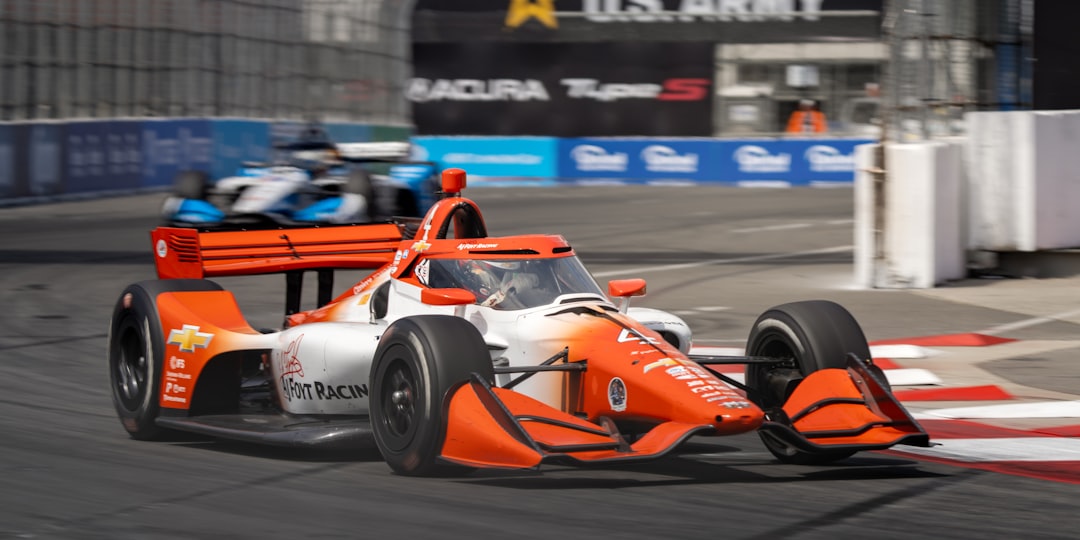
IndyCars are more standardized. Teams have less room for custom designs, which keeps costs down. But it also means less room for crazy speed innovations.
Race Strategy and Costs
Here’s where things get interesting. F1 teams spend hundreds of millions every year. They develop new parts for every race. It’s an engineering arms race!
IndyCars are more about driver skill and team strategy. The lower costs mean closer racing and less domination by one or two teams.
So while F1 might be quicker per lap, IndyCar races are often more unpredictable—and possibly more exciting for some fans.
Here’s a Quick Breakdown
| Category | Formula 1 | IndyCar |
|---|---|---|
| Top Speed | ~220 mph (354 kph) | ~240 mph (386 kph) |
| Lap Time (Road Course) | Faster | Slower |
| Car Design | Custom & High-Tech | Standardized |
| Cost | $Millions per car | Much Cheaper |
| Power Unit | Hybrid Turbo V6 (~1000 HP) | Twin Turbo V6 (~750 HP) |
So, Is IndyCar Faster Than F1?
It depends on what you mean by “faster.”
- Top Speed: IndyCar wins on ovals.
- Lap Times: F1 wins on road courses.
- Tech and Acceleration: F1 has the edge.
In the end, F1 is generally faster when you look at overall performance and lap times. But IndyCar has the need-for-speed edge on certain tracks—and a more level playing field for teams.
Final Thoughts
If you love precision engineering, bleeding-edge tech, and dancing on the edge of physics, F1 is your jam.
If you prefer heart-pounding overtakes at 230 mph on a blazingly fast oval, then IndyCar’s got your name on it.
But one thing’s for sure: Both are insanely fast, and the world is lucky to have them.
Now go watch a race—you’ve earned it!